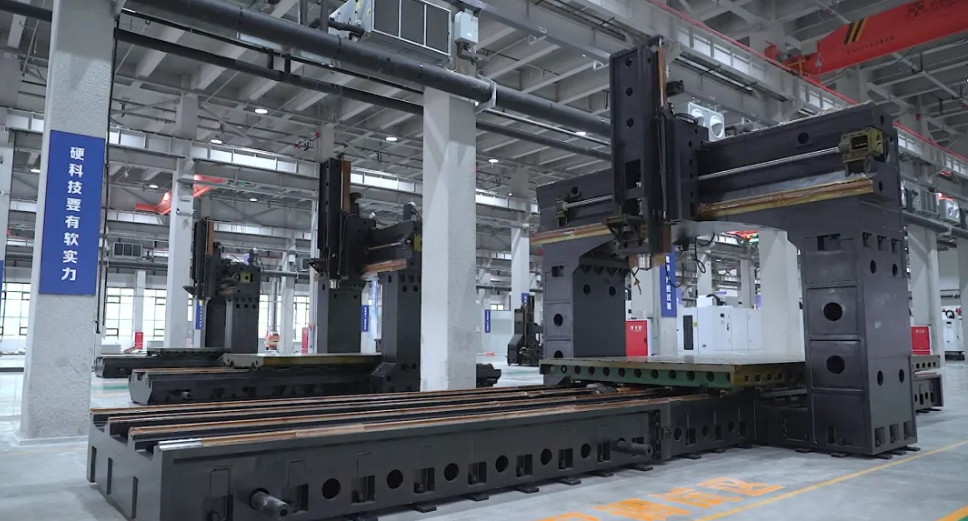
The core of precision machining is "dynamic stability", and the MCV-1020BA has made breakthroughs in both guide rails and structure dimensions:
Differentiated guide rail configuration
The X/Y axes adopt linear guides to achieve high-speed rapid movement at 30m/min (rapid movement speed 30/30/20 m/min), with positioning accuracy reaching 0.005mm/300mm.
The Z-axis is a square hard rail, which is quenched and hardened (hardness ≥HRC55) and precisely ground. The slide surface is covered with Turcite-B wear-resistant plates, and the friction coefficient is reduced to 0.04. When milling S45C steel at a depth of 5mm (cutting feed 5000mm/min), the vibration amplitude is controlled within 0.002mm. It not only meets the requirements of high-speed response but also ensures the rigidity of heavy cutting.
Finite element optimized structure
The column, base and saddle are all box-shaped closed structures, reinforced with cross-shaped ribs. The finite element analysis has verified that the rigidity of the entire machine is 50% higher than that of the traditional open structure.
The symmetrical column design and the optional nitrogen-oxygen counterweight system prevent torque imbalance during single-side cutting. The precision attenuation within a 1020mm stroke of the X-axis is ≤0.003mm, solving the problem of "precision dimension reduction during long-stroke processing" for medium-sized workpieces.
Thermal deformation and chip accumulation are the "invisible killers" of long-term machining accuracy. The MCV-1020BA achieves precise control through three technologies:
Ball screw pre-tensioning and hollow cooling
The X/Y/Z axis ball screws are all pre-tensioned to counteract the thermal expansion caused by high-speed rotation, and the thermal deformation is compressed to 0.001mm/100mm.
The optional ball screw hollow oil-cooled design further reduces the influence of thermal expansion. After continuous processing for 12 hours, the dimensional deviation is stabilized within ±0.005mm.
Spindle ring spray and through-cooling:
The spindle head is integrated with a ring spray device. The coolant evenly covers the tool and workpiece in a ring shape. Combined with the spindle cooler (standard configuration), the temperature rise of the spindle is controlled within 2℃.
An optional spindle through-cooling device (with a pressure of up to 60 bar) is available. When drilling deep holes (with a diameter of 48mm), the tool life is extended by 35%, and the radial runout of the spindle caused by high temperature is avoided (the measured runout is ≤0.002mm).
Front-mounted chip screw system
The chips are forcefully pushed off to the front-mounted chip screw and quickly conveyed to the chip conveyor for discharge. The chip removal efficiency reaches 367cc/min (S45C face milling), avoiding local temperature rise caused by chip accumulation. When the ambient temperature fluctuates by ±5℃, the equipment accuracy deviation is only 0.002mm, which is 40% more accurate and stable than the traditional side-mounted chip removal method.
The MCV-1020BA offers two tool magazine configurations, precisely matching different production requirements:
Conical tool magazine (Standard configuration)
With a 16-tool capacity, bidirectional arbitrary tool selection, tool change time ≤2.5 seconds, the maximum tool size is 90×300mm (diameter × length), and the weight is 6kg. It is suitable for multi-process processing of medium and small-sized molds, such as the continuous process of "milling - drilling - tapping" of automotive door panel molds, with the proportion of auxiliary time reduced to less than 22%.
CAM tool magazine (optional)
With a 24-tool capacity and cylindrical CAM drive for tool changing, the reliability of the operation has been enhanced by 50%. The random tool selection method supports more complex process switching. In the processing of aerospace aluminum alloy components (7075-T6, 150×150×25mm), the process switching time for a single workpiece has been shortened to 18 seconds, and the efficiency has been increased by 30%.
Standard spindle (8000RPM) :
The all-gear transmission design has an output torque of 47.7N · m (7.5kW spindle motor, S3 condition), which can meet the heavy cutting requirements of conventional materials such as 45# steel and aluminum alloy. When milling S45C steel (cutting depth 7.5mm), the surface roughness is stable at Ra1.6.
High-speed direct-coupled spindle (optional 15,000 RPM) :
The HSK taper design is suitable for high-speed processing of light metals. The processing time for the motor housing of new energy vehicles has been compressed from 3.5 hours to 1.8 hours.
For graphite processing, the dedicated configuration includes a "water curtain cover + graphite filtration device" to prevent dust from contaminating the electrical control box and harming the health of the operators. The processing accuracy of the graphite electrode reaches ±0.005mm, and the dust concentration is controlled below 0.5mg/m³ (in compliance with the GBZ2.1-2019 standard).

Scan the code to open the current page on your phone


微信公众号