At present, the medium-sized precision manufacturing field (such as automotive molds and aerospace structural components) is confronted with three core bottlenecks:
First, in heavy cutting scenarios, the rigidity of the equipment is insufficient, resulting in processing errors exceeding 0.015mm, and the pass rate is often lower than 85%.
The second is the accumulation of thermal deformation during long-term continuous processing, which causes the dimensional accuracy drift to reach 0.008mm/m.
Thirdly, traditional equipment lacks flexible configurations suitable for multiple processes, resulting in low tool changing efficiency and auxiliary time accounting for more than 30%.
The Hanmo Industrial MCV-1020A vertical comprehensive processing machine, through structured design optimization and precise matching of core technical parameters, provides quantifiable solutions for the above-mentioned industry pain points.
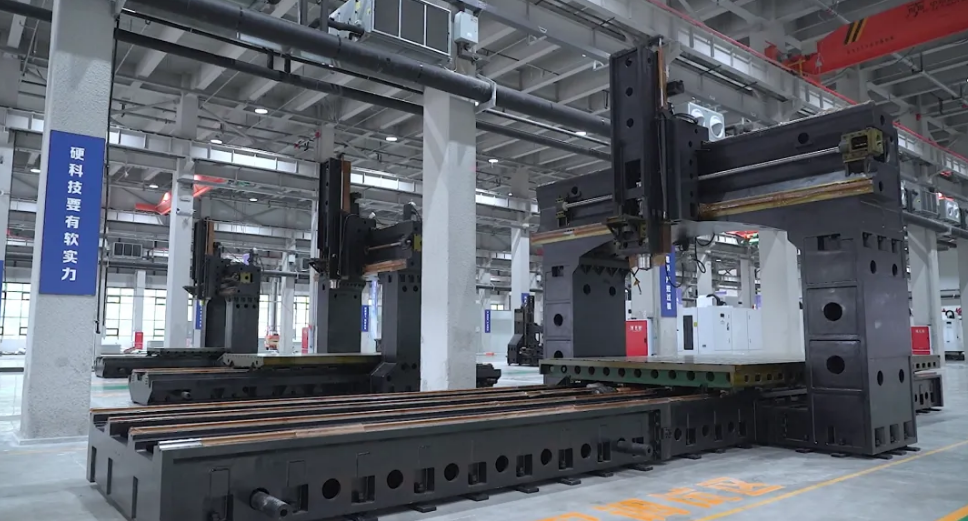
The stability of precision machining begins with structural mechanics design. The MCV-1020A breaks through in both material and structure dimensions:
High-rigidity castings and box structures:
The columns, bases and saddles are all made of high-strength cast iron and undergo overall aging treatment to eliminate internal stress.
The box-shaped structure combined with cross-shaped reinforcement ribs has been verified through finite element analysis to increase the overall rigidity of the machine by 45% compared to the traditional open structure.
In the 5mm depth end milling test of S45C steel, the vibration amplitude was controlled within 0.002mm, and the surface roughness was stable at Ra1.6.
Meet the precision milling requirements of automotive body panel molds (P20 steel, 420×360×60mm).
Symmetrical and balanced design
The columns adopt a symmetrical layout and balanced counterweight (nitrogen-oxygen counterweight is optional)
Avoid torque imbalance during single-side cutting
The positioning accuracy within a 1020mm stroke of the X-axis reaches 0.005mm/300mm, and the repeat positioning accuracy is 0.003mm.
Solve the problem of "precision attenuation during long-stroke processing" for medium-sized workpieces.
Thermal deformation is a key variable affecting long-term processing accuracy. The MCV-1020A achieves precise temperature control through a triple design:
Ball screw pre-tensioning treatment
The ball screws of the X/Y/Z axes have all undergone pre-tensioning process, effectively counterbalancing the thermal expansion caused by high-speed rotation.
Compress the thermal deformation of the lead screw to 0.001mm/100mm
Ensure that after continuous processing for 8 hours, the dimensional deviation is still controlled within ±0.005mm.
Main shaft ring spray cooling
The spindle head is integrated with a ring spray device, and the coolant evenly covers the tool and workpiece in a circular pattern.
In coordination with the main shaft cooler and the heat exchanger of the electrical control box,
Keep the temperature rise of the main shaft within 2℃
Avoid excessive radial runout of the main shaft caused by high temperature (measured runout ≤0.002mm).
All-domain heat dissipation layout
The spiral chip conveyors on both sides of the bed (standard configuration) can quickly remove chips and reduce the accumulation of cutting heat.
Semi-sealed protective cover (standard configuration) maintains a stable temperature in the processing area
When the ambient temperature fluctuates by ±5℃, the accuracy deviation of the equipment is only 0.002mm.
The MCV-1020A spindle adopts a full-gear transmission design and is equipped with NL40/NL50 taper hole specifications to achieve a balance of high and low speed operation accuracy.
At the rated speed, the output torque reaches 47.7N · m (7.5kW spindle motor, S3 condition), which can meet the deep hole drilling requirements of 45# steel φ48mm (cutting feed 5000mm/min), and the chip removal capacity reaches 367cc/min.
The spindle ring spray cooling system extends the tool life by 30%. In the processing of aluminum alloy 7075-T6 components (150×150×25mm), there is no chipping phenomenon during continuous cutting, and the processing efficiency is 25% higher than that of traditional equipment.
The equipment is equipped with an automatic tool changer featuring BT40/BT50 tool holders. The core parameters and performance are as follows:
The tool magazine has a capacity of 20/25 tools (optional), supports random tool selection, and the tool change time is ≤2.8 seconds. The maximum tool diameter is 90mm, the length is 300mm, and the weight is 6kg. It is suitable for multi-process compound processing from milling to tapping.
In the processing of automotive transmission housings, through the continuous process switch of "milling - drilling - tapping", the processing time for a single workpiece has been shortened from 45 minutes to 32 minutes, and the proportion of auxiliary time has dropped below 20%.
The parameter design of MCV-1020A precisely matches the processing requirements of medium-sized workpieces. Its core compatible scenarios include:
Automotive mold field
The 1250×640mm worktable (with a maximum load of 1000kg) can directly clamp large automotive door panel molds. The X-axis 1020mm travel enables full surface processing in one clamping, and the dimensional accuracy of the mold cavity is controlled within ±0.005mm.
Aerospace accessories
For the aluminum alloy 7075-T6 structural component (430×430×80mm), through spindle ring spray cooling and thermal error compensation, the shape and position tolerance remains ≤0.008mm after 8 hours of processing, meeting the aviation-grade precision requirements.
General machinery manufacturing
It can be optionally equipped with a fourth-axis rotary table and a deep hole drilling device, which is suitable for multi-faceted processing of complex parts such as gearbox bodies and pump bodies, and the equipment utilization rate has been increased to over 75%.
The MCV-1020A, with its structured innovation and parameter optimization, has demonstrated that domestic vertical machining centers have the technical strength to compete on an equal footing with international brands. The realization of each of its technical indicators is a solid support for the localization of precision manufacturing.
Scan the code to open the current page on your phone


微信公众号